What to Say in a Yin Yoga Class (and When to Stay Silent)
One of the biggest questions I hear from yin yoga teachers is, “How do you balance speaking and silence during long holds?”
You don’t need to fill every moment of silence with words. Guide students to settle in, wait about a minute after they settle into each pose, then offer a short reflection or simply let the silence be.
When I asked 80 yin teachers about their biggest sequencing challenge, about 20 of them named some version of this.
Finding the balance between offering guidance and allowing students to experience silence in stillness can be challenging, especially when you’re holding poses for 3–5 minutes or longer.
I have three different approaches to this.
Approach 1: Wisdom Drops Throughout Class
During the first yin pose, which I typically hold for 5–10 minutes, I begin by offering a few cues to help students fully arrive in the space.
I might say something like:
“You’ve carved out the next 60 minutes for yourself. You’re physically here, but can you give yourself permission to be mentally here as well? This is your invitation to close out all those mental tabs and be fully present with yourself.”
Then, I guide students through three-part breath, followed by a body, mind, and heart scan. This gives them an opportunity to check in with themselves and notice how they’re feeling physically, mentally, and emotionally.
Here’s an example of what I might say:
“Bring your attention to your breath. Begin to deepen your breath. Feel your breath physically moving through your lower belly, ribs, and heart space. For the next few breaths, focus on taking deep, long, slow breaths.
Now, bring your attention to your body. Mentally scan your physical body. Notice if there are any areas of tightness, tension, or spaciousness.”
Pause for 30 seconds.
“Now, bring your attention to your mind. Notice what’s on your mind right now.
Instead of trying to push those thoughts away, because what we resist often persists, can you simply name what’s on your mind?
Mentally complete the sentence: ‘What’s on my mind is…’
In the naming of it, it will lose power over you.”
Pause for 30 seconds.
“Now, check in with your heart. How is your heart feeling in this moment?”
Pause for 30 seconds.
“Let’s set a collective intention for today’s practice: to reconnect with ourselves in body, mind, and heart.”
After this opening, I guide students into the next yin pose.
From there, I introduce a theme and share what I like to call “wisdom drops” throughout class.
Wisdom drops are short but powerful reflections related to the class theme. I typically wait about one minute after students settle into a pose before sharing one. Sometimes I offer a wisdom drop in every pose, and other times I share one in every other pose, allowing more space for silence.
After savasana, I return to the body, mind, and heart scan from the beginning of class. I invite students to check back in with themselves and notice what, if anything, has shifted during their time on the mat.
Why I love this approach: I find it works especially well for students who are new to yin yoga and may struggle with the stillness. The wisdom drops give their minds something meaningful to focus on without filling the entire practice with talking.
Example Theme: What Is Yin?
Yin Yoga is a powerful yet passive practice where we typically hold poses for 2–5 minutes. The goal of yin yoga isn’t how a pose looks, but rather how it feels. If you’re feeling sensation in the intended target area, you’re practicing yin yoga!
I invite you to let go of the idea of how a pose should look. In yin yoga, we focus on target areas rather than achieving a specific pose. Instead of asking yourself, “Do I look like the person next to me?” ask, “Am I feeling sensation in the intended area?”
It’s all about finding your Goldilocks position: not too much, not too little, but just right.
We want enough sensation to feel a stretch, but not so much that we’re experiencing pain or struggling to stay in the pose.
And remember, your Goldilocks position might look different from someone else’s, and it might even look different from one day to the next.
The invitation on your mat today is to find your Goldilocks position. A place where you feel sensation in the intended target area, your breath can remain deep and steady, and you’re not experiencing pain. Remember, you don’t need to push deeper to get more out of your practice.
Invitation to mentally repeat, “I notice the sensations in my body. I listen to my body.”
Wisdom Drops for This Theme
- Yin yoga isn’t about how a pose looks, but how it feels. Take a moment to notice where you’re experiencing sensation. Are you feeling it in the intended target area? Remember, the goal isn’t to do the perfect pose or achieve a shape, but instead to explore sensation.
- Your body is constantly communicating with you through sensation. The question is, are you listening? Notice what your body is telling you right now. Is it inviting you to explore a little more depth, or is it asking you to back out?
- Check in with yourself. Have you found your Goldilocks position? Not too much, not too little, but just right. Remember, you want enough sensation to feel something, but not so much that you’re experiencing pain or struggling to stay in the pose.
- Bring your attention to your breath. Is it deep and steady, or are you holding it? Sometimes our breath can tell us when we’ve gone too far. If you’re struggling to breathe comfortably, consider backing out of the pose.
- Your Goldilocks position might look completely different from the person next to you, and that’s okay. We all have different bodies, different ranges of motion, and different experiences. Can you let go of what the pose is supposed to look like and focus on what you’re feeling?
- Take a moment to notice the sensations in your body. Have they changed since you first entered the pose? Perhaps the sensation has softened, intensified, or moved somewhere else. You don’t need to do anything about it right away. Simply notice.
- Yin yoga invites us to explore sensation, but there’s a difference between discomfort and pain. A stretching sensation may be appropriate, but sharp, pinching, or painful sensations are signals to adjust or come out of the pose. Remember, you never need to push through pain.
- Notice the difference between needing to come out of a pose and wanting to come out of a pose.
- How often do we ignore what our bodies are telling us because we’re focused on what we think we should be doing? Yin yoga gives us an opportunity to practice something different: listening. Noticing. Responding. Can you carry that same awareness beyond your mat?
Approach 2: Gradually Transition From Guidance to Silence
With this approach, I do most of the talking during the first half of class and gradually introduce more silence during the second half.
In the first pose, which I typically hold for 5–10 minutes, I invite students to notice how they’ve arrived.
I might say something like:
“Take these first few moments to notice how you’ve shown up today. How are you feeling physically? How are you feeling mentally?”
Then, I guide them through a pranayama practice. Depending on the class, this might be:
- Three-part breath: Bringing awareness to the belly, ribs, and chest.
- Soothing breath: Lengthening the exhale so it’s longer than the inhale.
- Square breath: Inhaling, holding, exhaling, and holding for equal counts.
After the breathwork, I introduce the class theme.
During the first half of class, I continue sharing wisdom drops related to that theme. Just like in the first approach, I usually wait about a minute after students settle into a pose before offering a reflection.
As we move into the second half of class, I gradually stop sharing wisdom drops and allow students to experience longer periods of silence, speaking only when necessary to guide transitions or offer options.
Why I love this approach: The first half of class gives students guidance and something to reflect on. The second half invites them to turn inward and sit with those reflections in silence, allowing them to deepen their connection with themselves.
Rather than filling every moment of stillness with words, I give students the opportunity to experience the practice for themselves.
Approach 3: Mostly Silence
With this approach, I begin class the same way I would with Approach 1 or Approach 2.
I choose one of those openings to help students arrive, connect with their breath, and turn their attention inward.
After the opening, I allow silence to become the main experience of the practice. I guide students into and out of poses, offering the necessary cues and variations, but I don’t share wisdom drops throughout the holds.
Instead, I give students space to sit with their breath, their thoughts, and whatever arises in the stillness.
Then, around the halfway point of class, I choose a longer yin hold to share a meaningful passage or reading related to the class theme.
After the reading, I return to silence for the remainder of the practice, speaking only when needed to guide students through the sequence.
Why I love this approach: It allows students to experience longer stretches of uninterrupted stillness while still offering a meaningful reflection to contemplate. Rather than providing ongoing guidance, I give students the opportunity to explore their own internal experience.
The Three Approaches at a Glance
| Approach | What you say | Best for |
|---|---|---|
| Wisdom drops throughout class | A guided opening, then a short reflection about a minute into every pose or every other pose | Students new to yin who find stillness hard |
| From guidance to silence | A guided opening with breathwork, wisdom drops in the first half, then mostly quiet in the second half | Mixed groups |
| Mostly silence | A guided opening, quiet holds, and one reading at the halfway point | Students who are comfortable with stillness |
So, Which Approach Should You Use?
There isn’t one right way to balance speaking and silence in a yin yoga class.
Sometimes students benefit from more guidance, especially if they’re new to yin and aren’t accustomed to spending several minutes in stillness. Other times, the most powerful thing you can offer is space.
I encourage you to experiment with all three approaches and notice how your students respond.
Remember, you don’t need to fill every moment of silence with words.
“The magic of yin happens in stillness and silence.”
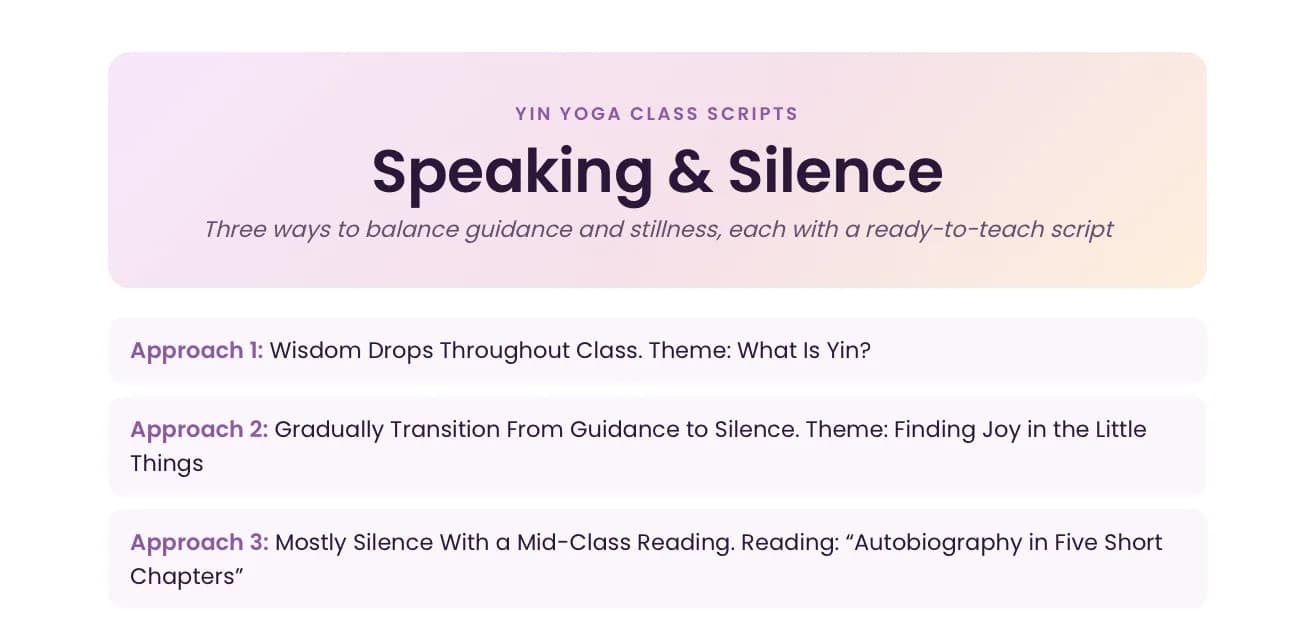
PDF, 0.1 MB
Frequently asked questions
How long should I wait before speaking in a yin pose?
I normally wait about one minute after students settle into a yin pose before sharing a wisdom drop. This gives them time to find their edge, connect with their breath, and experience some silence before I offer a reflection.
Should savasana be guided or silent in yin yoga?
It can be nice to offer a guided relaxation or yoga nidra during savasana, but I would definitely leave at least three minutes of savasana in complete silence. This gives students an opportunity to experience stillness.
Should I play music in a yin yoga class?
I love playing instrumental music in my yin yoga classes, but there isn’t a right or wrong answer. Silence can be very challenging for some students, and I also know some incredible yin teachers who play music with lyrics. It’s about understanding the purpose of your music or silence, knowing who you’re teaching, and choosing what aligns with you as a teacher.
How do I offer prop options without sounding rushed?
Teach prop options in progressions, starting with the most accessible variation and gradually offering more challenging options. I recommend choosing two or three options that you think will work for the majority of your students. If you notice someone who needs a different variation, go over to that student and offer an individual option rather than explaining additional variations to the entire class.
What do I say when students come into and out of a pose?
After I’ve cued the pose and offered variations, I typically stay silent for the first minute. Then, depending on my approach to the class, I’ll either share a wisdom drop or continue allowing silence. When it’s time to come out of the pose, I usually say, “Take a deep breath in and a deep breath out.” Then, I guide students into a rebound, counterpose, or the next pose in the sequence.
Where do I find readings or poems for a yin theme?
Inside the Yin Sequencing Studio, of course! 😉 You can also save readings that inspire you when you come across them on social media. Create a saved folder called “Yin Inspo” so you can return to those readings when you’re preparing your classes. And don’t forget to look for inspiration in your everyday life! Did something inspire you in a book you’re currently reading? Did you hear something meaningful on a podcast? Did something you watched on TV move you? There is inspiration all around you!
How do I stop over-cueing?
Remember, yin yoga isn’t about getting the perfect pose. It’s about students experiencing sensation in the intended target areas. You don’t need to micromanage every movement or constantly adjust how students look in a pose. Instead, give students clear instructions, offer a few options so they can find their edge, and allow them to explore what feels right in their own bodies.