What 123 Yoga Teachers Find Hardest About Yin Yoga Sequencing
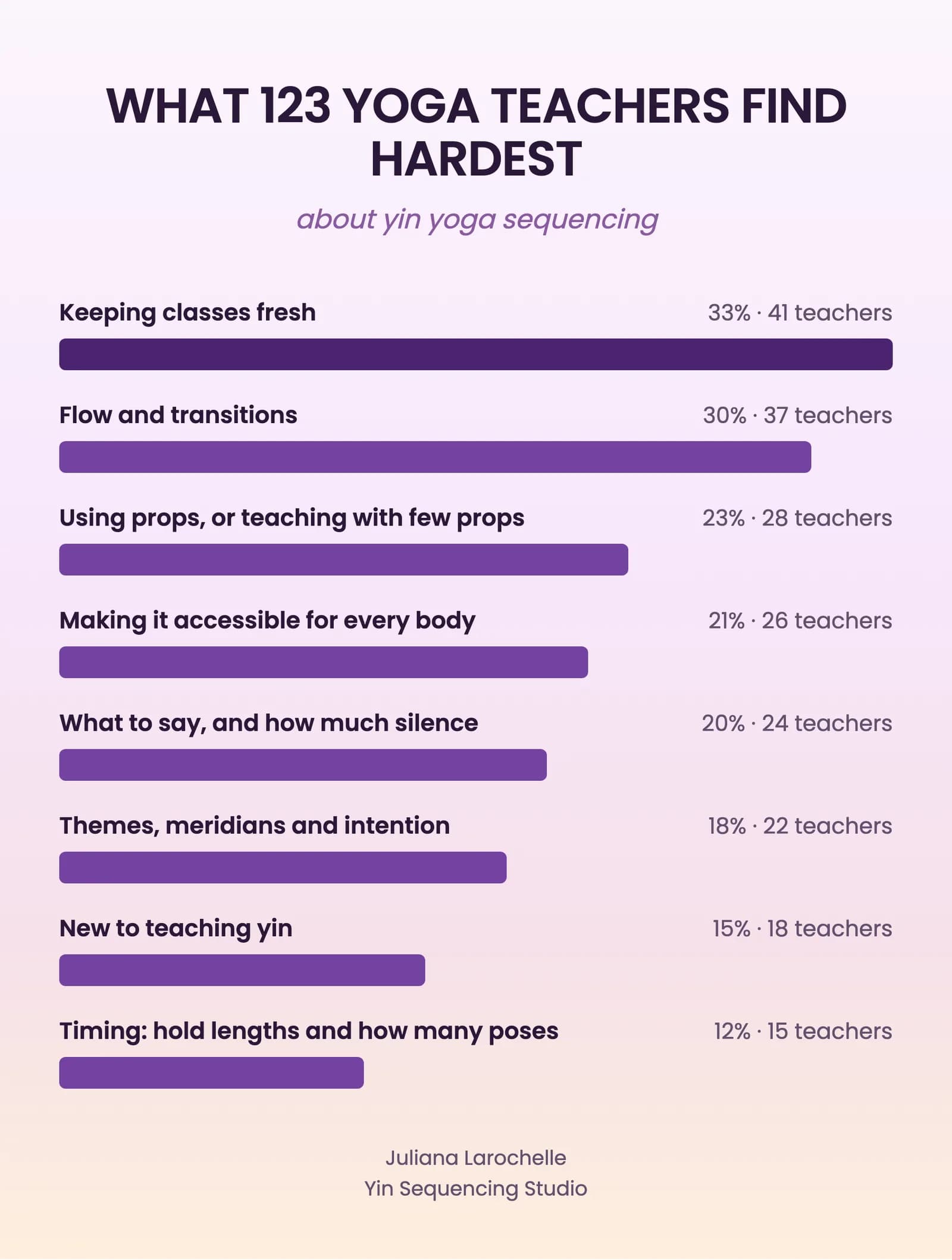
The biggest sequencing challenge for yin yoga teachers is keeping classes fresh. One in three yoga teachers shared some version of this struggle: “Keeping it fresh,” “Doing the same sequences over and over again,” or “I feel like I repeat the same poses for every class.”
Other common challenges included creating a yin class that flows, knowing how to use props (or teach without them), and making yin accessible for every body.
When teachers signed up for my free Creative Yin Sequencing workshop, I asked them two questions:
- What is your biggest challenge when it comes to sequencing yin yoga?
- What is your #1 question when it comes to building creative yin sequences?
123 teachers answered, from the US and Canada to Germany, Norway and Dubai. Some are still in their 200-hour training. Some have taught yin for over ten years. I read every single answer and sorted them into categories. Many teachers mentioned more than one challenge, so the numbers add up to more than 123.
The results
| Challenge | Teachers | Share |
|---|---|---|
| Keeping classes fresh | 41 | 33% |
| Flow and transitions | 37 | 30% |
| Using props, or teaching with few props | 28 | 23% |
| Making it accessible for every body | 26 | 21% |
| What to say, and how much silence | 24 | 20% |
| Themes, meridians and intention | 22 | 18% |
| New to teaching yin | 18 | 15% |
| Timing: hold lengths and how many poses | 15 | 12% |
1. Keeping classes fresh (33%)
This was the biggest challenge! So many of you teach the same students every week and worry they’re getting bored. With only 26 fundamental yin yoga poses, it’s easy to feel like you’re repeating the same poses over and over again. But keeping your yin classes fresh is easier and more accessible than you might think! Here are my ideas for keeping your yin classes fresh for your regular students.
2. Flow and transitions (30%)
Teachers want a yin class that feels connected and intentional, not random. They don’t want a choppy or disconnected sequence where students go from reclining to tabletop, then right back to reclining again. Here’s how I sequence a yin class that feels connected, and here’s my favorite way to do it: sequencing where the props don’t move.
3. Props (23%)
Two different problems showed up here. Some of you teach in gyms, community centers, parks or online, with only blocks and straps, or no props at all. Others have props but want to use them more creatively, without a lot of fussing. Here’s a full class with just two blocks and no bolster.
4. Making it accessible (21%)
Sensitive knees. Older students. Neck and shoulder issues. Students who can’t lie on their belly, or can’t take weight on their hands and knees. Many of you teach a room full of different bodies and want every student to feel safe and supported. This is the theme I’ll be writing about next.
5. What to say, and how much silence (20%)
How much should I talk? When should I stay quiet? How do I avoid saying the same thing every class? Here’s how I balance speaking and silence, with the exact words I use.
6. Themes, meridians and intention (18%)
Teachers want every pose to connect to a bigger picture: a meridian, a season, an intention. My seasonal class plans are built this way, like Winter Solstice Yin for the Kidney and Bladder meridians and Autumn Yin for the Lung and Large Intestine meridians.
7. New to teaching yin (15%)
Many of you come from vinyasa or hatha, or just finished your training, and never learned how to build a yin class. If that’s you, start here.
8. Timing (12%)
How long should I hold each pose? How many poses fit in 60 minutes? Here’s exactly how I time my classes.
What I took away
Reading through your answers, my biggest takeaway is just how much more yin yoga education and resources we need. So many of us struggle with the same challenges when teaching yin, and I’ve been there too! That’s why I’m so passionate about the Yin Sequencing Studio and supporting all of you on your teaching journey.
Yin sequencing and teaching are skills, and skills can be learned! You can learn how to keep your classes fresh, create yin sequences that flow, teach with props (or with limited to no props), balance silence and speaking, incorporate meridian theory from Traditional Chinese Medicine (TCM), and confidently plan the timing of your classes.
You don’t have to figure it all out on your own, and you don’t have to master everything overnight. There is always room to learn, grow, and become a more confident and creative yin yoga teacher.
Thank you to every teacher who shared their challenges with me. 🙏🏼
Take a look at Yin Sequencing Studio
Frequently asked questions
What do yin yoga teachers find hardest about sequencing?
Keeping classes fresh. 41 of the 123 teachers surveyed (33%) said so, followed by flow and transitions (30%), props (23%) and accessibility (21%).
Who answered the survey?
123 yoga teachers who signed up for Juliana Larochelle’s free Creative Yin Sequencing workshop, from teachers still in training to teachers with over ten years of yin experience.
How were the answers counted?
Each answer was read and sorted into categories. Many teachers mentioned more than one challenge, so one answer can count under several categories.